Brazilian Cities Turn Climate Pledges Into Electric Bus, Waste and Budget Projects
Brazilian cities are advancing electric bus purchases, organic waste schemes and changes to public spending as local governments work to translate climate commitments into practical projects following COP30 in Belém.
According to an update from the Brazil Mutirão Program, procurement has been formalised for more than 200 electric buses, while waste projects under development are expected to process more than 30,000 tonnes of organic material annually once implemented.
Seven cities are also working to introduce climate budgeting, a system designed to connect emissions reduction and adaptation commitments with everyday financial decisions.
The programme brings together C40 Cities and the Global Covenant of Mayors for Climate & Energy, with support from Bloomberg Philanthropies. Launched during COP30 in November 2025, it draws on the Brazilian concept of mutirão: a collective effort involving communities, institutions and different levels of government.
Organisers say it has engaged more than 100 cities and state governments, with over 50 receiving direct support for projects covering transport, waste, climate budgeting and climate action planning.
Ana Toni, COP30 CEO, said:
“Climate policy is not just about targets. It is about ensuring clean air, quality public transport, safe and resilient infrastructure, economic opportunities and a fairer future. This is the spirit Brazil is taking to COP31. The only way to leave a liveable planet for our children and grandchildren is to act together, now, through a global, national and local mutirão – a collective effort.”
Electric Bus Purchases Move Forward
Transport is one of the programme’s principal areas of activity, with 12 subnational governments working on electric buses and active mobility projects.
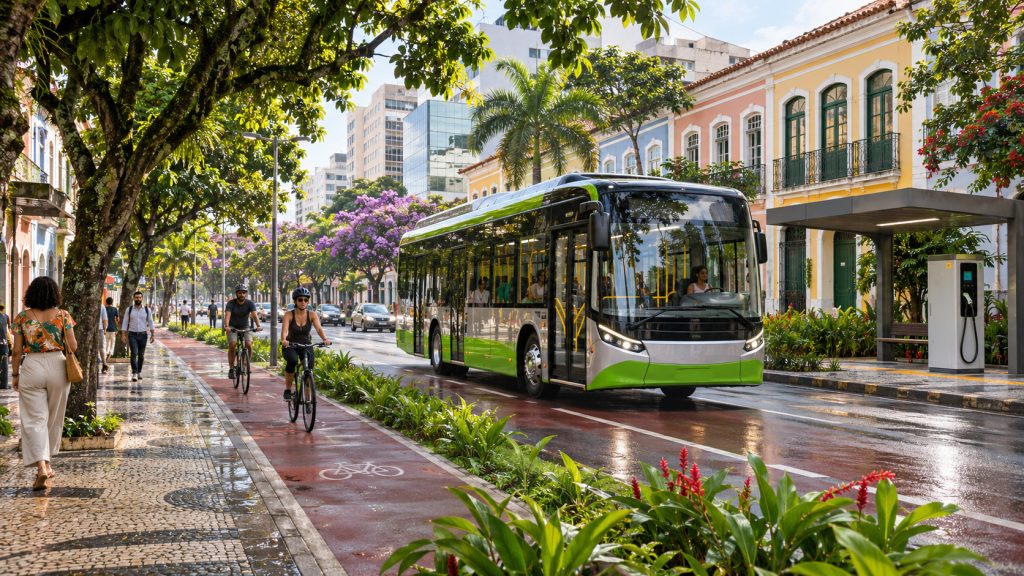
More than US$230 million has been mobilised with state and federal support for purchases of over 200 electric buses. Procurement has been formalised for 100 buses serving the Recife Metropolitan Region, 96 for Belo Horizonte and 27 for Montes Claros.
These purchases form part of a wider pipeline covering nearly 600 electric buses receiving technical support through the programme. The figures describe procurement and projects in development, rather than confirming that all the vehicles have entered service.
In Pernambuco, work on the Recife fleet has involved aligning vehicle purchases with routes, battery range and charging infrastructure ahead of a phased introduction.
Ilan Cuperstein, C40 Cities’ Regional Director for Latin America, said:
“The transition to zero-emission fleets is becoming an increasingly established part of public policy in Brazilian cities. Electrifying fleets brings direct benefits for the climate, public health, transport quality and the local economy. The clear message for other cities is that financing is no longer a barrier: proven pathways exist, and a network is ready to support municipalities”.
Organic Waste Projects Target Methane
Another strand addresses emissions from organic waste, which accounts for around half of Brazil’s municipal solid waste, according to the programme.
Food scraps, garden cuttings and other organic materials generate methane when they decompose in landfill. Diverting that material into appropriately managed treatment offers a way to reduce emissions while recovering useful resources.
Twenty-one subnational governments are developing 17 waste management projects, with an expected combined treatment capacity exceeding 30,000 tonnes annually once implemented.
Cities developing solutions include Curitiba, Guaxupé and Maracaju. In Benevides, Pará, an initiative connects waste management with environmental education across 41 municipal schools, potentially reaching more than 10,000 pupils.
Eduardo Pimentel, Mayor of Curitiba and C40 Cities’ vice-chair for Latin America, said:
“Managing organic waste means transforming our relationship with the environment. By scaling up composting, we reduce methane emissions, cut the volume of waste sent to landfill, and produce fertiliser for urban agriculture and green spaces. This initiative builds on Curitiba’s heritage as a pioneer of waste separation in Brazil and a benchmark for environmental action.”
Connecting Climate Targets With Public Spending
Climate budgeting seeks to make commitments part of routine government decisions, assigning responsibility across departments and identifying where funding supports—or works against—climate objectives.
Salvador established its Municipal Climate Governance Policy in September 2026, integrating climate action into public policy, urban planning and the municipal budget. It supports implementation of the city’s mitigation and adaptation plan, which includes an ambition to reach carbon neutrality by 2049.
Campinas has announced that, from 2028, it will formally identify expenditure that contributes to or undermines climate targets.
Curitiba signed a climate budgeting decree in October 2026. A committee led by its Finance Secretariat will support implementation, monitoring and evaluation.
Ana Paula Matos, Deputy Mayor of Salvador, said:
“There is no concrete public policy without a guaranteed budget. By establishing our Municipal Climate Governance Policy, Salvador moves to track and prioritise resources in a smart, integrated way to protect those who need it most and the city’s most vulnerable areas.”
Amazon Cities Develop Local Plans
The programme is supporting 11 cities across the Amazon region. Six are developing local climate action plans, two are advancing sustainable mobility projects and three are working on waste initiatives.
The work aims to help municipalities identify climate risks, vulnerable communities and priorities for investment.
Cities are also using City Climate Compass, an artificial intelligence tool that brings together information about emissions, risks and vulnerabilities to support comparisons between possible actions.
Belém, the COP30 host city, is working on sustainable urban mobility through the Belo Centro historic centre revitalisation project.
Mayor Igor Normando said:
“People living in the Amazon need to have a voice in decision-making and see the results in their own communities. For Belém, tackling climate change means supporting those affected by flooding, expanding green spaces and improving conditions for people who travel across the city every day. This is the perspective guiding our efforts to advance climate planning and projects such as Belo Centro. Our commitment is to turn this agenda into tangible improvements, particularly for those who need them most.”
Delivery Depends on Coordinated Support
The update highlights cooperation between municipal, state and federal authorities as a recurring feature of the projects.
In Espírito Santo, a sustainable mobility initiative developed in Serra is set to expand to other municipalities, incorporating tree planting alongside transport improvements.
In Rio Grande do Sul, reconstruction following climate disasters is connecting resilience priorities with projects involving Caxias do Sul, Porto Alegre and the state’s food distribution centre, CEASA-RS.
Hélinah Cardoso, Head of Engagement for the Brazil Mutirão Program, said:
“Climate challenges do not respect administrative borders. When we connect local governments’ implementation capacity with policies, programs, and funding from the state and federal governments, we leverage structural projects that previously seemed impossible. This multilevel governance is the true engine in combating climate change and protecting people’s lives.”
The programme’s first-year update demonstrates progress in securing finance, formalising purchases and establishing governance arrangements. The next test will be delivery: bringing vehicles into service, operating waste treatment projects and tracking how budget changes translate into measurable emissions reductions and stronger protection for communities.
Sources/References
Brazil Mutirão Program — supplied update from the partnership between C40 Cities and the Global Covenant of Mayors for Climate & Energy, supported by Bloomberg Philanthropies. Project figures and quotations are attributed to the release.