Russia Could Pursue Space-Based Nuclear Weapons to Counter Growing US Military Capabilities, RUSI Warns
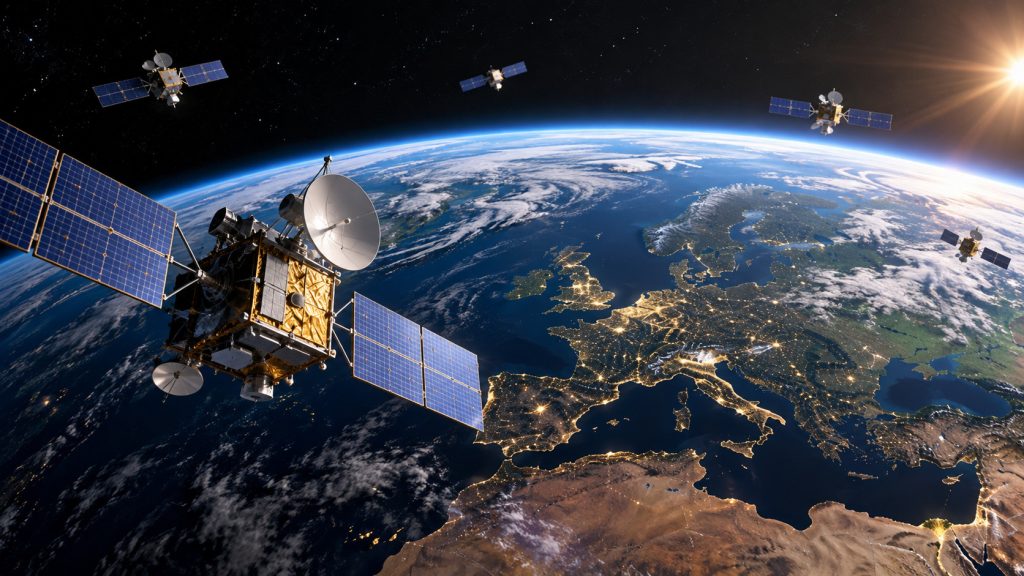
New RUSI research examines the potential development of Russian space-based nuclear weapons and the implications for global satellite infrastructure. Original AI-generated illustration, created for Global Business News. Not an actual photograph of Russian military satellites.
New defence research suggests Moscow may prioritise advanced nuclear and anti-satellite capabilities over expanding its existing arsenal, raising concerns about the future security of space infrastructure.
Russia could increasingly focus on developing space-based nuclear weapons and other advanced offensive military systems over the next decade as it seeks to counter improvements in American intelligence, surveillance and missile defence capabilities.
That is the conclusion of a new report published by the Royal United Services Institute (RUSI), which examines how Russia’s nuclear weapons strategy could evolve in response to technological developments in the United States and among its allies.
The report, Russia’s Nuclear Deterrent and Its Weapons Procurement, was written by Dr Sidharth Kaushal, Senior Research Fellow at RUSI, with research conducted between October 2025 and June 2026.
Published on 8 October 2026, the analysis suggests Moscow is becoming increasingly concerned about the vulnerability of its nuclear arsenal to sophisticated American conventional strike systems, satellite-based surveillance and improving missile defences.
Rather than simply increasing the number of nuclear weapons it possesses, Russia may seek capabilities designed to undermine the technological infrastructure supporting Western military operations.
These could potentially include nuclear weapons deployed in orbit, despite longstanding international restrictions prohibiting such systems.
US Surveillance and Missile Defences Driving Russian Concerns
According to RUSI, Russia’s nuclear modernisation priorities are being shaped by concerns about the increasing sophistication of American military technology.
Advances in space-based intelligence, surveillance and reconnaissance allow military forces to identify and monitor potential targets with greater accuracy.
When combined with long-range conventional weapons and missile defence systems, these capabilities could, in Moscow’s assessment, threaten the survivability of parts of its nuclear arsenal.
This is particularly significant because nuclear deterrence depends partly on an adversary believing that a country would retain sufficient weapons to retaliate following an initial attack.
RUSI argues that expanding the number of nuclear warheads would not necessarily address Russia’s concerns about increasingly capable American intelligence and targeting systems.
The report states:
“Russia cannot simply build its way out of the problem through numerical expansion.”
Instead, Moscow may prioritise systems capable of disrupting the networks and technologies that support US and allied military operations.
Space-Based Nuclear Weapons Could Become a Strategic Priority
One of the report’s most significant findings concerns the potential development of nuclear weapons intended for use against satellites.
RUSI identifies growing Russian interest in the effects of high-altitude nuclear detonations, including research by state-affiliated academics into how nuclear explosions could disrupt satellite systems through radiation, ionospheric disturbances and plasma effects.
Such weapons could potentially affect large numbers of satellites simultaneously, rather than requiring individual satellites to be targeted.
The report states:
“From the standpoint of military utility, opportunity cost and relative organisational simplicity, there appears to be a strong case for Russia to eventually field space-based nuclear weapons.”
However, the assessment concerns Russia’s potential strategic incentives and should not be interpreted as confirmation that Moscow has deployed an operational nuclear weapon in orbit.
The 1967 Outer Space Treaty prohibits placing nuclear weapons or other weapons of mass destruction in orbit around Earth.
Any Russian deployment of such a system would therefore raise serious international legal and security concerns.
Nuclear Detonation Could Affect Thousands of Satellites
The research also examines the potentially extensive consequences of a nuclear explosion in space.
According to RUSI’s analysis, a single 110-kiloton nuclear detonation in space could affect approximately 20% of satellites in orbit, depending on the circumstances.
The report states:
“A single detonation of a 110-kiloton weapon in space has the potential to have an impact on around 20% of the satellites in orbit, also potentially mitigating the problem of proliferating commercial ISR.”
The figure is a scenario-based estimate rather than a prediction of what would happen in every possible detonation.
Unlike conventional anti-satellite weapons, which generally target individual spacecraft, a nuclear explosion could produce widespread effects across orbital infrastructure.
The potential consequences would extend beyond military satellites.
Commercial satellite networks support telecommunications, navigation, weather forecasting, financial transactions and international transport systems.
Damage to these networks could therefore create substantial economic disruption affecting governments, businesses and consumers around the world.
The growing use of commercially operated satellite imagery by Western military organisations is another factor identified in the report.
Russia may view these privately operated systems as an increasingly important part of the intelligence infrastructure supporting its adversaries.
However, any widespread attack on satellites would also risk damaging systems used by Russia and other countries, potentially producing consequences far beyond the intended military targets.
Russia Expected to Retain Greater Reliance on Silo-Based Missiles
The report also predicts that Russia may place greater emphasis on land-based intercontinental ballistic missiles housed in hardened silos.
This reflects concerns that mobile missile launchers could become easier to detect and target as surveillance technology improves.
RUSI identifies the RS-28 Sarmat intercontinental ballistic missile as an important component of Russia’s longer-term nuclear planning.
The report states:
“Russia will probably consolidate more of its throw weight and critical payloads in silo-based systems.”
Silo-based missiles offer advantages in maintaining established command-and-control arrangements and supporting rapid launch procedures.
However, their fixed locations also create vulnerabilities, meaning the balance between mobile and stationary nuclear forces remains an important strategic consideration.
The report’s assessment does not establish that all planned Russian missile systems will enter service on their intended schedules.
Advanced Nuclear Torpedoes and Cruise Missiles Also Examined
Beyond space-based weapons, RUSI considers several other advanced Russian military programmes.
These include the Burevestnik nuclear-powered cruise missile, designed to offer an unusually long operating range, and Poseidon, an intercontinental nuclear-powered underwater weapon.
Both systems have attracted international attention because of their unconventional designs and potential implications for nuclear deterrence.
The report also examines hypersonic glide vehicles, directed-energy weapons and electronic warfare capabilities intended to interfere with satellites and other space-based systems.
These technologies could provide Russia with additional options for challenging Western military advantages.
However, their development and deployment will depend on technical feasibility, production capacity, financial resources and changing strategic priorities.
Financial Pressures Could Limit Russia’s Nuclear Ambitions
Despite Russia’s emphasis on nuclear modernisation, RUSI warns that the cost of developing and producing advanced weapons will remain a major constraint.
The report challenges assumptions that Russia can modernise its nuclear arsenal substantially more cheaply than the United States because of lower labour costs.
It states:
“The relative cost of new nuclear weapons for Russia is comparable to that of the US and has at times exceeded it, notwithstanding significantly lower Russian labour costs.”
This finding suggests Russia may face difficult decisions about which weapons programmes to prioritise.
Investing in new strategic systems could place pressure on other areas of military expenditure, particularly as the country continues to devote substantial resources to conventional military operations.
The research indicates that financial considerations could be as influential as strategic objectives in determining which systems Russia ultimately develops and deploys.
Implications for International Security and the Global Economy
The prospect of nuclear weapons being deployed in space raises concerns extending beyond relations between Russia and the United States.
Modern economies are heavily dependent on satellite infrastructure for services including GPS navigation, international communications, banking, logistics and environmental monitoring.
An attack that damaged a significant proportion of operational satellites could affect commercial activity across multiple sectors and continents.
There would also be implications for the rapidly expanding commercial space industry, including satellite operators, launch providers and businesses developing space-based communications networks.
For governments, the report highlights the growing importance of protecting space infrastructure and developing alternatives to systems that could become vulnerable during a major international conflict.
It also raises questions about the effectiveness of existing arms control arrangements as military technology develops.
The Outer Space Treaty remains a central element of international space law, but advances in counterspace weapons and military satellite capabilities are creating challenges for the established framework.
A Warning About Future Capabilities, Not Confirmed Deployment
RUSI’s findings represent an assessment of Russia’s potential military procurement priorities over the coming decade.
They do not establish that Russia has already deployed nuclear weapons in orbit or that the development of such weapons is inevitable.
Instead, the report argues that advances in American military capabilities are creating incentives for Moscow to explore weapons that could threaten the systems supporting Western intelligence and defence operations.
The analysis suggests that the future of nuclear deterrence may increasingly depend not only on the number and destructive power of nuclear weapons, but also on the resilience of the technological infrastructure used to detect, track and respond to threats.
For international policymakers and businesses dependent on satellite services, the findings underline the growing relationship between military competition in space, global economic security and the future of strategic arms control.
Sources and Further Reading
Primary research: Royal United Services Institute (RUSI), Russia’s Nuclear Deterrent and Its Weapons Procurement, published 8 October 2026.
Research author: Dr Sidharth Kaushal, Senior Research Fellow, RUSI
Research conducted between October 2025 and June 2026.